The Australian and New Zealand Journal of Psychiatry (ANZJP) Grading of Recommendations, Assessment, Development, and Evaluations (GRADE) Guidelines for the Management of Schizophrenia
Key Points
The ANZJP GRADE Guidelines provide updated evidence-based recommendations for the management of schizophrenia in Australia and Aotearoa New Zealand.
The guidelines are organised across seven key areas: physical health assessment, pharmacological treatment, psychological and psychosocial interventions, family/whānau and carer involvement, psychiatric comorbidities, physical health and lifestyle interventions, and special populations.
The GRADE approach distinguishes between strong recommendations, where benefits clearly outweigh harms for most people, and weak or conditional recommendations, where clinical decisions require greater individualisation.
First-line antipsychotic recommendations prioritise second-generation agents with more favourable cardiometabolic profiles, including aripiprazole, brexpiprazole, cariprazine and lurasidone.
The guidelines place strong emphasis on proactive cardiometabolic monitoring and management, including lifestyle interventions, early metformin use, and consideration of GLP-1 receptor agonists for antipsychotic-related weight gain.
Clozapine remains the recommended treatment for treatment-resistant schizophrenia, while long-acting injectable antipsychotics should be offered as a treatment option in the maintenance phase.
Psychological, psychosocial and family-focused interventions are central to care, including psychoeducation, cognitive behavioural therapy for psychosis, cognitive remediation therapy, metacognitive therapy, and collaborative family/whānau/carer involvement.
The guidelines emphasise shared decision-making, lived experience involvement, collaboration with family/whānau and carers, appropriate clinician training and supervision, and thoughtful medication management.
Ten years after the publication of the previous Royal Australian and New Zealand College of Psychiatrists (RANZCP) clinical practice guidelines [Galletly et al., 2016], the Australian and New Zealand Journal of Psychiatry (ANZJP) Grading of Recommendations, Assessment, Development and Evaluations (GRADE) Guidelines for the Management of Schizophrenia in Australia and Aotearoa New Zealand [Suetani et al., 2026] have recently been published.
The 2016 RANZCP Clinical Practice Guidelines Summary
The ANZJP GRADE Guidelines consist of seven sections:
- Physical health assessment,
- Pharmacological treatment,
- Psychological and psychosocial interventions,
- Family, whānau and carer involvement,
- Psychiatric comorbidities,
- Physical health and lifestyle interventions, and
- Special populations.
The ANZJP GRADE Guidelines also outline four overarching principles:
I. Shared decision‑making;
II. Collaboration with family, whānau and carers;
III. Adequate training and appropriate supervision for clinicians; and
IV. Thoughtful medication management
The ANZJP GRADE Guidelines were developed using the GRADE approach. [Guyatt et al., 2008]
This approach involves identifying key health questions and addressing them through systematic evaluation of the certainty of available evidence, before formulating either strong or weak/conditional recommendations. Strong recommendations indicate that benefits clearly outweigh harms for most people and should be considered standard care, whereas weak/conditional recommendations reflect lower certainty or a closer benefit-to-harm balance, requiring greater individualisation based on personal circumstances and preferences.
Gain a thorough understanding of schizophrenia
Study schizophrenia staging, aetiological factors, treatment options and management methods. Join Academy by Psych Scene to access our comprehensive course on schizophrenia and earn CME/CPD points.
Check out the course
RECOMMENDATIONS
The ANZJP GRADE Guidelines present 18 strong and 15 weak recommendations. A summary of these recommendations is presented in Table 1.
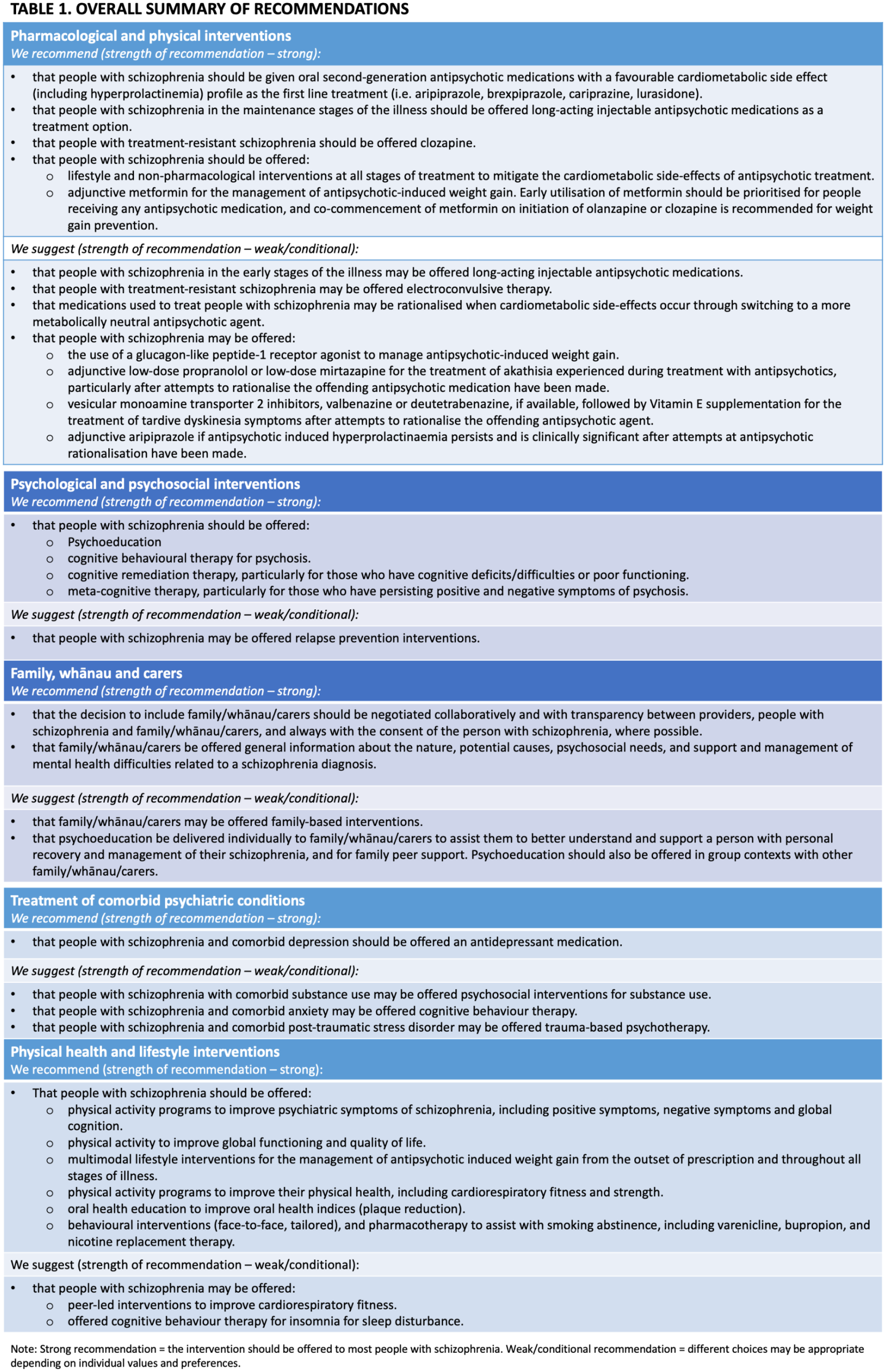
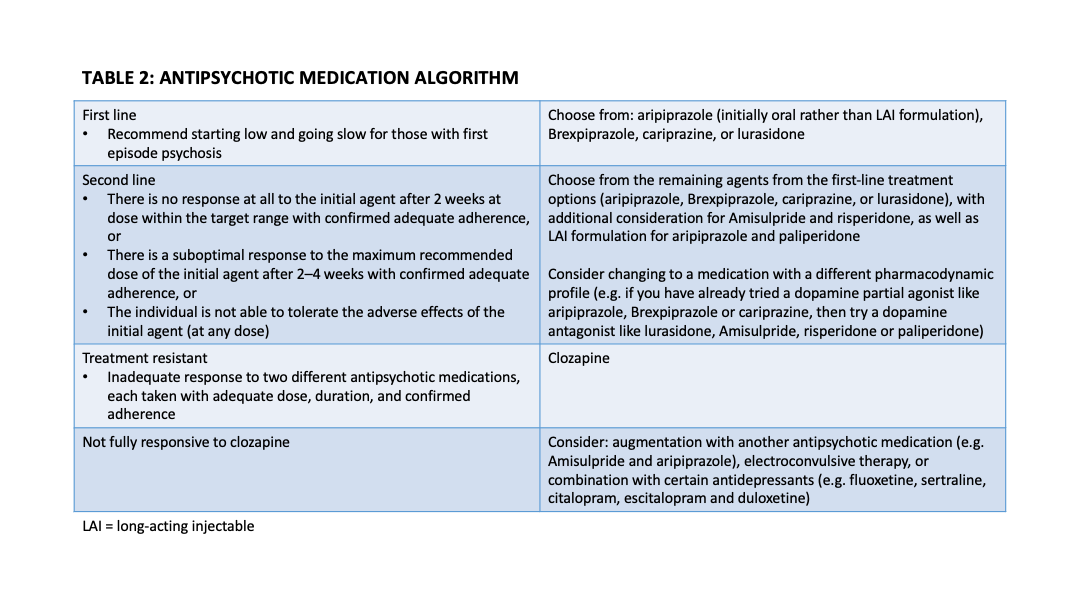
Of particular note, while the previous RANZCP guidelines [Galletly et al., 2016] already highlighted the importance of physical health in people living with schizophrenia, the ANZJP GRADE Guidelines place even greater emphasis on this area. For example, the recommended first‑line antipsychotic medications, aripiprazole, brexpiprazole, cariprazine and lurasidone, were chosen largely because they have more favourable cardiometabolic profiles. Table 2 outlines the antipsychotic medication algorithm included in the ANZJP GRADE Guidelines.
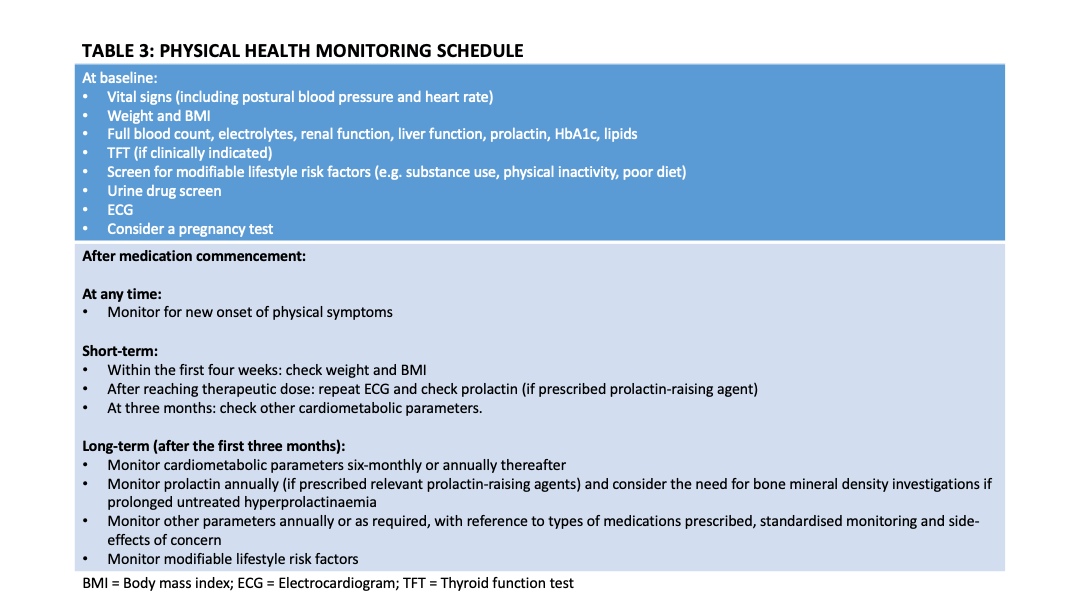
Further, the ANZJP GRADE Guidelines also emphasise the need for regular monitoring and proactive management of cardiometabolic side effects. They include recommendations to use metformin early, with early utilisation for most and co-commencement on initiation for those being started on olanzapine or clozapine, and to consider glucagon‑like peptide‑1 receptor agonists to help reduce antipsychotic‑related weight gain.
The Guidelines also highlight the essential role of lifestyle interventions, such as physical activity programs, multimodal lifestyle interventions, and smoking‑cessation services, as routine components of care for people with schizophrenia.
Table 3 outlines the suggested physical health monitoring schedule included in the ANZJP GRADE Guidelines.
In addition, the ANZJP GRADE Guidelines sought more explicit involvement of people with lived experience. In addition to having a section on family, whānau and carer involvement, the Guidelines also have an author with lived experience, and the development process was assisted by the consumer consultation group consisting of seven individuals with lived experience of schizophrenia.
CLINICAL IMPLICATIONS
The recently published ANZJP GRADE Guidelines aims to bring together the best current evidence across key areas of schizophrenia care, providing practical recommendations that can be used in everyday clinical practice as well as in broader service planning and policy. Even so, as the RANZCP has emphasised, guidelines are an “evidence‑based document intended to support clinical decision‑making in specific circumstances”. [Kisely et al., 2024] As such, these recommendations should be implemented with thoughtful clinical judgement, considering the individual needs, preferences, and circumstances of each person with schizophrenia and their family, whānau, and carers.
Affiliations:
- Queensland Centre for Mental Health Research, The University of Queensland, Wacol, Australia.
- School of Medicine and Dentistry, Griffith University, Nathan, Australia.
- Metro South Addiction and Mental Health Service, Metro South Health, Brisbane, Australia.
- School of Health, Medicine and Behavioural Sciences, The University of Queensland, Brisbane, Australia.
Declaration of conflicting interest:
Both authors contributed to the ANZJP GRADE guidelines. SS served as an associate editor of the ANZJP and has received an honorarium from SAGE Publishing (2025). SS was on the Seqirus medication advisory board for cariprazine (2020 to 2022). SS has also received honorarium from Inside Practice Psychiatry (2021) and GroupH (2021). DS is deputy editor of the ANZJP. DS serves on the Viatris Australian Clozapine Quality Advisory Committee and has received honorarium for independent educational talks from Servier, Otsuka, Douglas, Viatris and Lundbeck.
RELATED LEARNING
- To build on the guideline-based management of schizophrenia discussed in this article, clinicians may find Schizophrenia: Advanced Clinical Approaches & Training for Psychiatrists on The Academy by Psych Scene particularly valuable. The course explores the construct of schizophrenia, staging, diagnostic considerations, aetiological factors, pharmacological and non-pharmacological treatment approaches, and schizophrenia treatment guidelines.
- Clinicians interested in the cardiometabolic implications of antipsychotic prescribing may also find Antipsychotic Weight Gain and Metabolic Syndrome (MetS) valuable. The course explores antipsychotic-induced weight gain, metabolic syndrome, cardiometabolic risk, and pharmacological and non-pharmacological strategies for managing metabolic complications in clinical practice.
FAQs
1. What are the ANZJP GRADE Guidelines for schizophrenia?
The ANZJP GRADE Guidelines are evidence-based recommendations for the management of schizophrenia in Australia and Aotearoa New Zealand. They bring together current evidence across pharmacological treatment, psychological and psychosocial interventions, physical health, comorbidities, family/whānau and carer involvement, and special populations.
2. What does the GRADE approach mean?
GRADE stands for Grading of Recommendations, Assessment, Development and Evaluation. It involves identifying key clinical questions, systematically evaluating the certainty of available evidence, and developing recommendations based on the balance of benefits, harms, evidence quality and clinical relevance.
3. What is the difference between strong and weak recommendations?
A strong recommendation means the intervention should be offered to most people with schizophrenia because the benefits clearly outweigh the harms. A weak or conditional recommendation means different choices may be appropriate depending on the individual’s circumstances, preferences, values and clinical context.
4. Which antipsychotics are recommended as first-line treatments?
The guidelines recommend oral second-generation antipsychotics with favourable cardiometabolic side-effect profiles as first-line treatment. These include aripiprazole, brexpiprazole, cariprazine and lurasidone.
5. When is clozapine recommended?
Clozapine is recommended for treatment-resistant schizophrenia. The article defines this as an inadequate response to two different antipsychotic medications, each taken at an adequate dose and duration, with confirmed adherence.
6. What role do long-acting injectable antipsychotics have?
Long-acting injectable antipsychotics should be offered as a treatment option for people with schizophrenia in the maintenance phase. The guidelines also suggest that they may be offered in the early stages of illness, depending on clinical circumstances and patient preference.
7. Why do the guidelines emphasise physical health?
The guidelines place strong emphasis on physical health because antipsychotic treatment can contribute to cardiometabolic side effects, and people with schizophrenia experience a substantial physical health burden. The recommendations include baseline and ongoing monitoring, lifestyle interventions, smoking-cessation support and proactive management of antipsychotic-induced weight gain.
8. What psychological and psychosocial interventions are recommended?
The guidelines recommend psychoeducation, cognitive behavioural therapy for psychosis, cognitive remediation therapy and metacognitive therapy. Relapse prevention interventions may also be offered, depending on individual needs and preferences.
9. Are the guidelines intended to replace clinical judgement?
No. The article emphasises that guidelines are intended to support clinical decision-making, not replace it. Recommendations should be applied with thoughtful clinical judgement, taking into account the individual’s needs, preferences, circumstances and family/whānau/carer context.
Get Serious About Psychiatry Learning
Our courses offer practical knowledge and clinical expertise at exceptional value, plus CME & CPD points.
Go to Academy by Psych Scene